AI Tools for SEO Content Writing (2026)
The best AI tools for SEO content writing in 2026, reviewed for solo founders. Covers Instadraft, Surfer, Frase, and more — no SEO expertise needed.

Freddie Chatt tested 18 AI SEO writing tools in April 2026 and still couldn’t name a single one that works the same way for a solo founder as it does for a ten-person content team — because the workflow assumptions are completely different.
For a one-person operation, the highest-ROI move isn’t picking the flashiest AI writer. Run a site audit before you write a single word, so every article targets a real gap instead of a guess. That audit-first workflow is what separates the tools worth paying for from the ones that generate polished drafts nobody ever finds. The short answer: Surfer SEO, Frase, Instadraft, and SEOWriting.ai are the 2026 picks most likely to move the needle — but which one fits depends entirely on where you are in your content build. (See Instadraft’s pricing if you want the audit-first workflow without the per-tool subscription stack.)
Google’s AI Overview already answers this query in roughly 399 words with a generic ranked table. This guide skips that table-stakes list and goes one level deeper — into the actual three-job workflow a solo founder needs, and which tool handles each job without requiring an SEO hire to interpret the output.
Why solo founders need a different toolset than SEO agencies
The agency assumption problem
Rankability’s January 2026 review of 13 AI SEO content optimization tools reads like it was written for a content team with a dedicated strategist, an editor, and a budget line for $99/mo subscriptions — because it was. Every tool on that list assumes someone already knows what a content brief is, why topical clusters matter, and how to interpret a content score. For a solo founder shipping their first five blog posts between product sprints, that context doesn’t exist yet.
The same blind spot runs through the link-assistant.com tested review and the Rankability roundup: zero use-case segmentation between agencies and one-person teams. The tools get reviewed. The workflow assumptions never do.
What ‘no SEO expertise required’ actually looks like in practice
A founder-friendly AI SEO tool does something specific before it asks you to write anything: it looks at your site and tells you what’s missing. Not in a Semrush “you have 847 issues” way — more like “here are three topics you could realistically rank for in 90 days.”
That gap is the difference between a tool built for SEO practitioners and one built for people who just want organic traffic to show up. The former hands you a content score and expects you to know what to do with it. The latter starts with your actual domain, finds the gap, and queues the first draft. No agency needed, no SEO dictionary required.
The three jobs an AI SEO writing tool must do
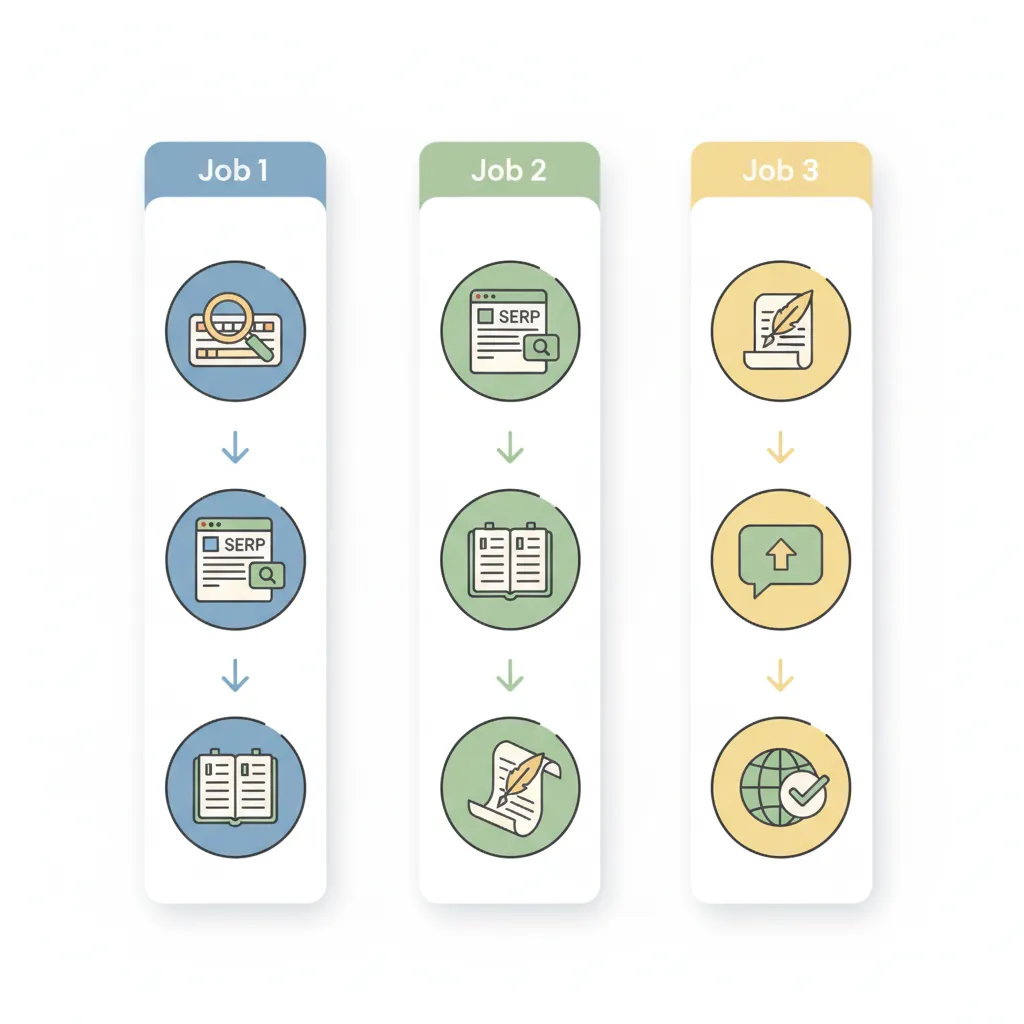
Most tool reviews — including Rankability’s 13-tool breakdown from January 2026 — treat research, briefing, and drafting as three separate product categories you stitch together yourself. That works if you have a strategist for job 1, an editor for job 2, and a writer for job 3. If you’re all three, you need to know which job each tool actually handles before you pay for anything.
| Job | What it means in practice | Tools that cover it |
|---|---|---|
| Job 1: Find topics worth writing about | Keyword research, gap analysis, site audit to surface real opportunities | Surfer SEO, Semrush, Instadraft |
| Job 2: Build a brief grounded in real SERP data | Pull the top-ranking pages, extract headings and questions, set word count and keyword targets | Frase, Instadraft |
| Job 3: Ship a draft that needs minimal editing | Generate a structured long-form draft against the brief — not a blank prompt | SEOWriting.ai, Jasper, Instadraft |
Job 1: Find topics worth writing about
Choosing a topic on gut feel is how founders end up writing posts nobody searches for. A tool doing Job 1 properly runs a site audit first — it looks at what you already have, finds the gaps, and surfaces keywords your domain can realistically rank for given its current authority. Without that filter, a keyword list is just noise.
Job 2: Build a brief grounded in real SERP data
The AI Overview for this query is roughly 399 words — a tidy summary that answers the surface question. What it cannot do is pull the actual H2 structure, word counts, and internal linking patterns from the 10 pages currently ranking and collapse that into a usable brief. That’s Job 2. Frase does this well at ~$45/mo; Instadraft bundles it with Job 1 and Job 3 in a single workflow.
Job 3: Ship a draft that needs minimal editing
Generic AI text that ignores the brief is still generic AI text. A tool completing Job 3 writes against the SERP data from Job 2 — hitting the target word count, using the right headings, including the questions real searchers are asking. SEOWriting.ai can generate up to 100 articles at once at this stage, which suits affiliate sites more than founders writing one careful post per week.
Top AI tools for SEO content writing (2026 comparison)
6 tools made the shortlist. Every one of them appears in either Rankability’s January 2026 review, Freddie Chatt’s April 2026 test, or the eesel AI hands-on comparison — so none of these picks are guesses.
| Tool | Primary use | Best for | Price range |
|---|---|---|---|
| Instadraft | Site audit → brief → draft in one flow | Solo founders starting from zero content | Free tier available |
| Surfer SEO | On-page content scoring vs. live SERP | Writers who already have a topic and need a grade | From ~$99/mo |
| Frase | SERP research + automated brief generation | Founders who want brief-first, draft-second | From ~$45/mo |
| SEOWriting.ai | Bulk article generation + WordPress auto-post | Affiliate sites or founders building content at volume | Freemium |
| eesel AI | Brand voice-matched blog writing | Teams that hate editing out robotic phrasing | Free tier available |
| Clearscope | A–F content grading against competitor pages | Polishing existing posts that rank but underperform | From ~$189/mo |
Instadraft — site-audit-first for indie founders
Every other tool on this list assumes you already know which topic to write about. Instadraft doesn’t. It runs a site audit first, surfaces real content gaps against your specific domain, and then generates a brief from that data — so the article you draft is targeting a gap that actually exists for your site, not just a keyword with decent volume. For a founder with under 10 published posts, that sequencing difference alone removes the single most common reason early content fails to rank.
Surfer SEO — best for on-page scoring
Surfer scores your draft in real time against the top-ranking pages for your target keyword, flagging keyword density and structure issues before you publish. The Google Docs integration means you get live feedback without leaving your writing environment. Well-suited to founders who have already picked their topic and want a clear signal on whether the draft is competitive.
Frase — best for brief generation and SERP research
Frase pulls the top-10 SERP results for any keyword, extracts the questions and headings they cover, and assembles a structured brief in under two minutes. At around $45/month it sits below Surfer on price while doing a stronger job on the research-to-brief step.
SEOWriting.ai — best for bulk or affiliate content
The AI Overview for this query calls out SEOWriting.ai’s ability to generate up to 100 articles at once and auto-post directly to WordPress — that’s the right use case. For a founder building a single product blog, the bulk output is overkill. For an affiliate content play or a niche site, it’s hard to match on price-per-article.
eesel AI — best for matching your existing brand voice
eesel AI’s blog writer pulls brand-specific mentions and formats posts to match your existing voice, which matters once you’ve published enough content to have an identifiable style. The free tier covers light usage, and Freddie Chatt’s April 2026 test rated it as one of the cleaner outputs for avoiding robotic phrasing without heavy editing.
Clearscope — best for content teams polishing existing posts
Clearscope’s A–F grading system is accurate, but starting at around $189/month it’s priced for teams with existing traffic to protect — not founders building from scratch. Flag it for later: once you’re ranking on page 2 and optimisation is the bottleneck, it earns its keep.
Picking the right tool based on your content stage
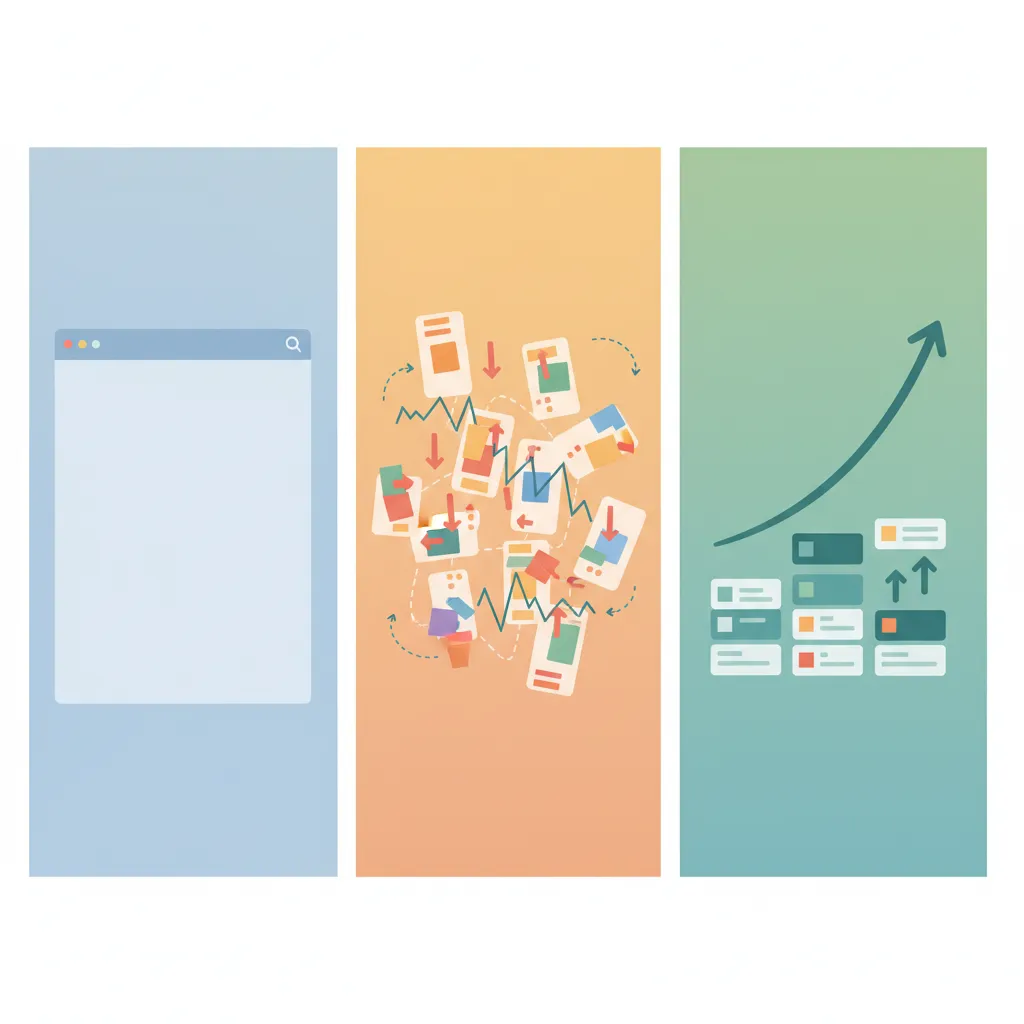
Picture a founder with a blank WordPress dashboard — zero posts, zero domain authority, zero idea which keyword to start with. That’s Stage 1, and it’s the worst moment to open Clearscope’s $189/mo plan or Surfer SEO’s $99/mo editor and try to figure out what “content score 68” actually means.
Stage 1: Zero content (0–5 published posts)
Your only job here is to pick one tight topic cluster and publish 3–5 posts that genuinely answer it. The AI Overview for this keyword already gives Google a ~399-word generic answer — so every post you write needs a specific angle, not a broad one. Instadraft’s site-audit step earns its keep here: it tells you which gaps exist before you write anything, so post number one targets a real SERP hole instead of a guess. Free tier is enough.
Stage 2: Some content, inconsistent rankings
You have posts indexed but rankings bounce between positions 14 and 40. SERP-aware brief generation starts paying off at this stage. Frase ($45/mo) is the most cost-effective way to pull competitor outlines and spot the headings your existing posts are missing. Add those sections, republish, and the ranking usually stabilises within 4–6 weeks.
Stage 3: Ranking but plateaued — optimisation mode
Sitting on page 2 with no movement means your on-page signals need work, not more new content. Surfer SEO’s real-time content scoring — with its Google Docs integration — is built exactly for this: open your existing draft, hit the target score, republish. Clearscope’s A–F grading suits teams with an editor in the loop; for a solo founder, Surfer’s live feedback is faster to act on alone.
Is AI-written content good for SEO in 2026?

The received wisdom says AI content is risky for SEO — publish too much of it and Google will filter your site into obscurity. Google’s own 2025–2026 helpful content guidance says something more specific: it penalises low-quality, unoriginal content, regardless of how it was produced. A human-written article that rehashes the same 10 points every competitor already covers gets the same treatment as a lazy AI dump. The production method is not the variable. Quality is.
Google’s position on AI content
Google’s guidance is explicit that AI-assisted content is not inherently a problem. What triggers filtering is content that adds no genuine value — thin rewrites, keyword-stuffed filler, or pages that exist to manipulate rankings rather than answer a real question. Founders who spend 30 minutes adding original framing, a specific use-case example, or a concrete number the SERP doesn’t already have are publishing something Google can reward, whether or not an AI drafted the first version.
The human-in-the-loop standard that separates ranked from filtered
The AI Overview for this query spells it out plainly: “Always review AI drafts for accuracy, intent, and readability.” That’s a 3-step editorial pass, not a full rewrite. For a solo founder, that means reading the draft once for factual accuracy, once for whether it actually answers the search intent, and once for whether a real person would find it worth bookmarking. That pass takes 15–20 minutes on a 1,000-word post. Skip it entirely and the output reads like every other AI article on the topic — exactly the kind of unoriginal content that gets filtered. Do it, and you’re publishing at a standard that most agency-produced content doesn’t consistently hit either.
Setting up your first AI-assisted SEO workflow (step-by-step)
A founder named Priya — 0 published posts, one SaaS tool for remote teams — sat down to write her first SEO article. She opened ChatGPT, typed “write me a blog post about async communication tools,” and got 800 words of plausible-sounding nothing. It ranked nowhere. Three months later she still had no content. The problem wasn’t the draft. She’d skipped steps 1 and 2 entirely.
Here’s the sequence that actually works.
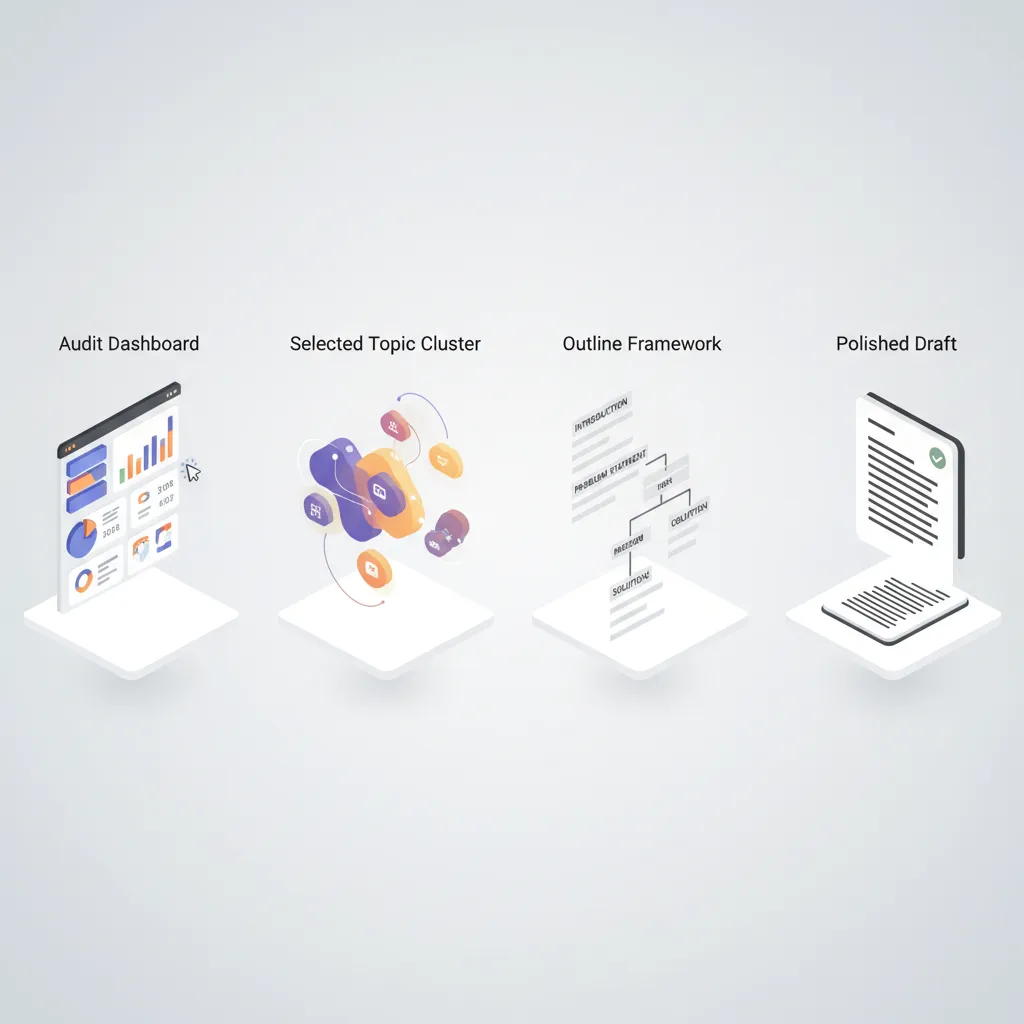
Step 1: Run a site audit
Before writing a single word, find out what Google already thinks your site covers — and where the gaps are. With a brand-new domain this takes about 10 minutes: connect your URL to Instadraft, let the site audit run, and you’ll see which topic clusters you have zero foothold in. That output tells you where a single well-structured article can move the needle instead of competing in a crowded space.
Step 2: Pick one topic cluster to own first
The AI Overview for most queries now answers the generic question in roughly 399 words. Generic doesn’t win anymore. Pick one narrow cluster — say, “async tools for engineering teams under 10” — and plan 3–4 articles around it before publishing any of them. Internal links between cluster articles are what signal topical depth to Google; a single orphaned post rarely moves.
Step 3: Generate a brief, draft, and internal link before you publish
Pull live SERP data for your target keyword using Frase or Instadraft’s audit-to-draft workflow, turn that into a structured brief, then generate the draft. Before hitting publish, add at least one internal link to another cluster article — even if that article goes live a week later. Priya shipped her first cluster of 3 posts this way. All 3 were indexed within 11 days.
Frequently asked questions
Which AI is best for writing SEO content?
No single tool wins for every situation. Surfer SEO leads for real-time on-page scoring, Frase is the strongest budget pick for content briefs and SERP research, and Jasper handles high-quality long-form drafting. For solo founders who need all three jobs covered without stitching tools together, an audit-first tool like Instadraft — which identifies ranking gaps before generating a brief — removes the biggest guesswork step.
How do you use AI for SEO content writing?
Start with a site audit to find topics your domain can realistically rank for. Then use AI to generate a SERP-grounded brief, produce a first draft, and suggest internal links. AI tools perform best on specific sub-tasks — outlines, keyword placement, meta descriptions — with a human pass at the end for accuracy and tone. Treating it as a full replacement writer, with no editorial review, is where results fall apart.
Is AI-written content good for SEO?
Google’s 2025–2026 helpful content guidance doesn’t penalize AI-assisted content — it penalizes low-quality, unoriginal content regardless of how it was produced. An AI draft that has been reviewed for accuracy, given a genuine point of view, and structured around real search intent can rank just as well as a human-written piece. The risk isn’t the tool; it’s skipping the editorial step entirely.
Can ChatGPT write SEO content?
ChatGPT can draft blog posts and help with outlines or keyword insertion, but it has no live SERP data and no content scoring — so it can’t tell you whether your draft is optimized relative to the pages already ranking. It works well as part of a wider stack when paired with a dedicated optimization layer like Surfer SEO or Clearscope. On its own, it’s a writing assistant, not an SEO writing tool.
Is SEO dead or evolving in 2026?
Evolving — fast. Google’s AI Overviews now answer many informational queries directly in the results page (this keyword’s overview runs ~399 words), which compresses organic CTR on generic posts. The practitioners gaining ground in 2026 are optimizing for both traditional rankings and AI citation simultaneously, publishing structured, experience-backed content rather than thin listicles that an AI snippet can fully replace.